Ever stood in front of a blank room staring at an empty wall, completely paralyzed by where to start? You aren't alone. Transforming a wide expanse of plain drywall into an inspiring backdrop feels intimidating, but filling it shouldn't feel like solving a calculus equation.
Finding Your Visual Voice and Selecting Art That Fits Your Style
When you start picking out artwork, try separating your personal taste from what you think should match your coffee table. Matching your upholstery fabric precisely often leaves a room feeling like a generic furniture showroom. Focus on building a cohesive mood instead.
Color palette plays a major role here. If you want a serene, grounded atmosphere, warm earth tones like sage green, soft terracotta, and chocolate brown create instant calm. Looking for drama and high energy? Rich jewel tones like deep emerald green, sapphire, and cobalt blue make an unmistakable impact.
Nature-inspired themes have taken off in home design over recent years. Research shows that 74% of homeowners feel significantly more relaxed and grounded when living with biophilic art, such as misty forest spaces or real pressed botanicals.¹
To keep your space from feeling chaotic, select one hero piece before buying anything else. This main artwork serves as your anchor. It is usually your largest or visually heaviest item. Once you position your anchor, your other prints, photos, and sketches can act as supporting cast members, balancing the room without competing for attention.
Planning Your Masterpiece with Needed Layout Techniques
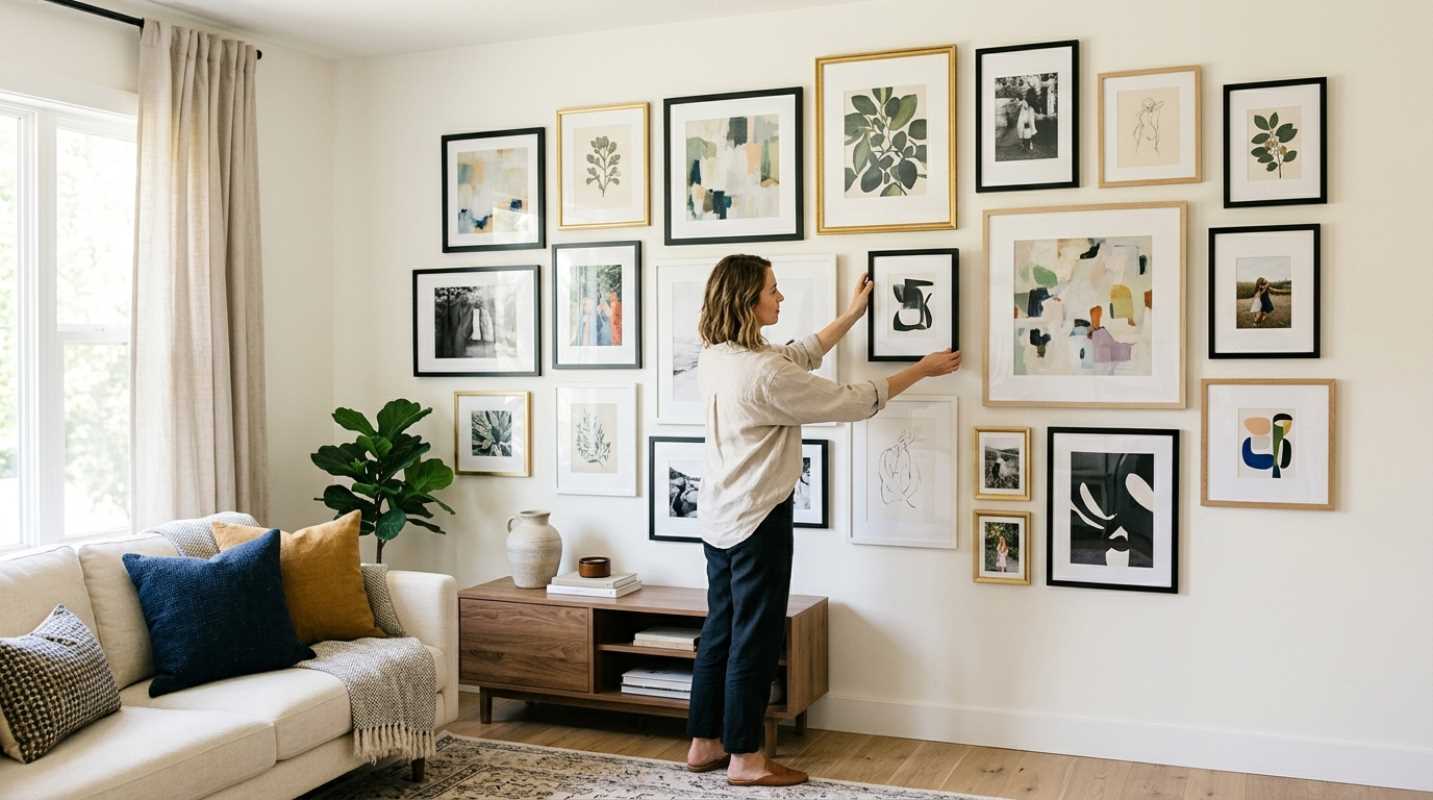
Rigid, cookie-cutter grid gallery walls are fading fast. Today, organic salon-style layouts that look like they were collected over years are taking center stage. But choosing an organic aesthetic doesn't mean you should skip planning.
Before driving a single nail into your wall, try the floor layout method. Clear out a patch of rug, measure the exact dimensions of your wall space, and start experimenting with frame arrangements on the ground.
If you love clean lines, symmetrical arrangements work wonderfully in formal spaces. But if you want a modern, relaxed home environment, asymmetrical layouts offer far more flexibility.
Designers rely on a few mathematical guidelines to keep artwork balanced
• The Eye-Level Standard: Center the visual midpoint of your gallery arrangement roughly 57 to 60 inches off the ground. This mirrors standard museum display heights.
• The Two-Thirds Ratio: Your total gallery width should span about 60% to 75% of the furniture width below it, whether that furniture is a sofa, headboard, or console table.²
• Furniture Clearance: Keep the bottom edges of your frames roughly 6 to 8 inches above the top of your sofa or table to prevent accidental bumps.³
• Spacing Consistency: Maintain a steady 2 to 3 inches of space between adjacent frames so your wall feels organized rather than cluttered.
The Art of Eclecticism and Mixing Frames Cohesively
Have you ever seen a gallery wall that blends an abstract canvas, a black-and-white family photograph, and a vintage oil painting, and somehow looks stunning? That balance happens when you mix media intentionally.
Combining flat paper prints with multidimensional textures creates immediate visual depth. Try pairing framed art with thick impasto brushstrokes, woven textiles, or pressed ferns in floating glass. Textured mats are another fantastic way to elevate small artwork, using linen, silk, or rich velvet matting inside your frames.
To blend various media without making your wall look messier than a flea market stall, keep these rules in mind
• Limit Frame Finishes: Stick to two or three complementary finishes across your wall, like natural oak, matte black, and warm brass.
• Establish a Shared Thread: Connect varied subjects using a shared accent color, matching mat borders, or consistent photographic tones.
• Incorporate 3D Elements: Break up flat picture frames by adding non-traditional objects like small round mirrors, ceramic tiles, or vintage wall sculptures.
Pro-Level Execution and Installation Secrets
Now comes the practical part: getting everything hung securely without leaving a dozen accidental holes in your wall.
Before picking up a hammer, trace each frame onto kraft paper or newspaper. Cut out the templates, label them, and stick them to your wall with painter's tape. This step lets you step back, adjust spacing, and preview your composition in real time.
Keep these needed tools nearby for a smooth installation
• A Bubble or Laser Level: Even slightly crooked frames spoil an otherwise great arrangement.
• Tape Measure and Pencil: Light pencil marks make sure precise spacing without permanently marking the paint.
• Appropriate Hardware: Use heavy-duty wall anchors for large glass frames, or non-damaging adhesive hanging strips for lightweight pieces in rental homes.
If you are decorating a dining room or home office, lower your art's center point by 4 to 6 inches. Because people spend most of their time sitting in those rooms, hanging pieces lower make sures they line up comfortably with seated eye levels.
Curating for the Long Haul and Changing Your Collection
The best gallery walls are never truly finished. Think of your wall as a changing canvas that changes as your life, tastes, and adventures grow. You don't need to purchase every frame in a single afternoon.
Collect original sketches, vintage postcards, or local photography when you travel. Mixing higher-end gallery finds with personal treasures, like family heirlooms or handwritten notes, gives your home genuine character.
Swapping out art seasonally is another simple trick to refresh a room without redoing your layout. Leave your primary frames mounted on the wall, but swap the artwork inside them as the seasons change. Slip crisp black-and-white architectural photos into frames for a cozy winter feel, then swap in soft watercolor spaces when spring arrives.
Building a collection takes time, so enjoy the process and trust your eye as your wall comes together.
Sources:
1. Wall Art Trends for 2025 and How to Style Them
https://sackstedersinteriors.com/blog/wall-art-trends-for-2025-and-how-to-style-them/
2. The Ultimate Guide to Choosing Wall Art for Your Space
https://www.meubles.ie/article/42-the-ultimate-guide-to-choosing-wall-art-for-your-space-in-2025
3. Rookie Mistake: Hanging Wall Art
https://thediyplaybook.com/rookie-mistake-hanging-wall-art/